How much time is your team losing between systems?
Stock in one place, orders in another, reports somewhere else. Answer eight questions to see where manual work, disconnected tools and missing visibility slow your operations, and get the first three things worth fixing.
Free. No sign-up. Your result appears as soon as you finish.
Your systems don't talk to each other. Someone does.
The ERP, the spreadsheets and the inbox each hold part of the picture, and a person carries information between them every day.
Where the information lives
- ERPOrders, invoices, stock
- SpreadsheetsThe steps the ERP doesn't cover
- Email and phoneOrders and updates from clients
- Suppliers and partnersFiles, portals and messages
Today
A person connects them by hand
- Retypes orders from one system into another
- Calls around to find out where a job stands
- Rebuilds the same report every week
What it costs
- Hours every weekSpent copying and checking
- ErrorsEvery retyped line is a chance for one
- Status that's already oldDecisions made on yesterday's numbers
The gaps between your tools cost time
Each tool may do its job. But information gets copied, checked and rebuilt as it moves between them, and the coordination behind it grows with the company.
89%
of operations leaders say their technology investments haven't fully delivered the expected results.
PwC, 2026 Digital Trends in Operations Survey767 operations and supply chain leaders at US companies with $100M+ annual revenue, surveyed January to February 2026.
1 in 4
spend seven or more hours a week copying information between applications, reconciling conflicting data and feeding context into AI tools by hand.
Workday and The Harris Poll, May 20262,400 UK finance, HR, IT and operations professionals who use AI at work, at organisations with 500+ employees, surveyed March 2026.
Both surveys cover large organisations, so read them as a signal, not a benchmark for a smaller team.
One process fixed, two hours back every day
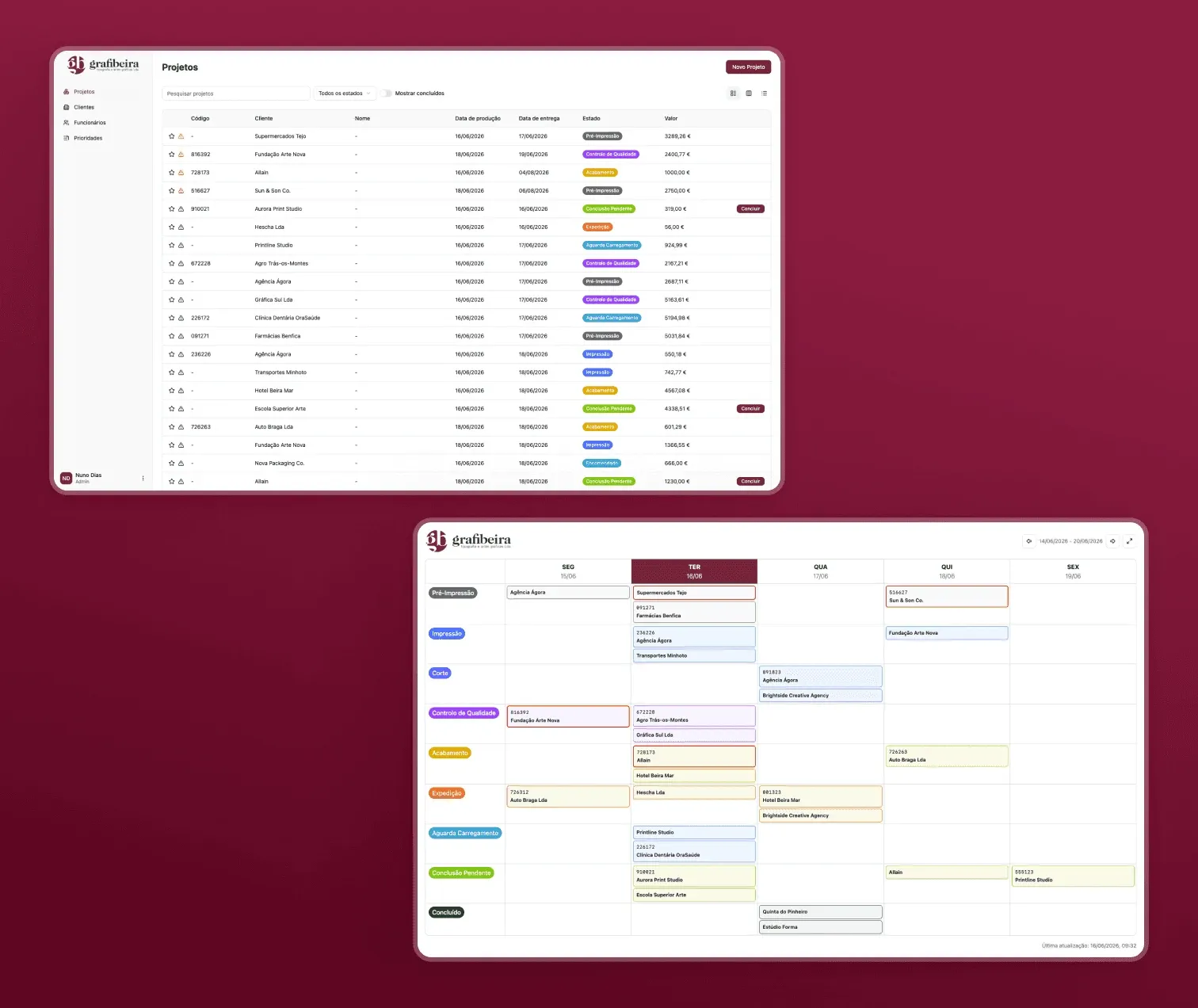
Grafibeira, a Portuguese print shop founded in 1983, ran production on paper job sheets, spreadsheets updated by hand and verbal status checks between departments. We replaced that one process with a production management system, built in four weeks.
 View Case Study
- Printing & Packaging
Grafibeira
A web app with a six-state production flow, a PIN for each employee, QR code checks before shipping, a live production panel for the floor and drag and drop priorities.
Outcomes
- • 2h saved daily
- • 10% increase in processed orders
- • 0% error rate since app adoption
- • 100% team adoption
Operations Efficiency Check
Find your biggest operational gap in two minutes
Choose the answer closest to how your team works today. There are no right answers, and your result appears as soon as you finish.
- Eight questions
- No sign-up
- Instant result
Your operations snapshot
/ 21
Where to look first
Your next three steps
What working with us would look like
A directional self-assessment, not a validated diagnostic or ROI forecast.
What your score means
Score 0 to 6
Connected operations
Your operations are connected, with a few areas worth tightening.
Your team can usually find reliable information, and most data moves without daily intervention. The best opportunity is likely one recurring exception, report or handoff.
Score 7 to 13
Hidden manual load
Your systems work because people fill the gaps between them.
Your answers point to regular copying, checking and coordination between tools. That hidden work limits how much the team can take on as the company grows.
Score 14 to 21
High fragmentation
Your team is carrying too much of the system.
Important information is spread across tools and people. Start with one high-value workflow, not a company-wide replacement project.
You don't need to replace every system
The right fix is often small. Connect two tools, remove one repeated handoff or build one reliable view. Start with the process causing the most friction and build only what the team needs; a focused change is easier to test, adopt and measure.
Connect what already works
Link the tools and information your team already relies on.
Remove repeated manual work
Cut the copying, checking and chasing between people and systems.
Build only what's missing
A focused internal tool, when existing software can't support the process properly.
Want a second opinion on one process?
Bring one process that takes more time or attention than it should. We'll show you where we'd look first and whether a focused software change is worth it.
Prefer to write? Get a quote